How to Cheat in Chess.com Using Browser Extensions
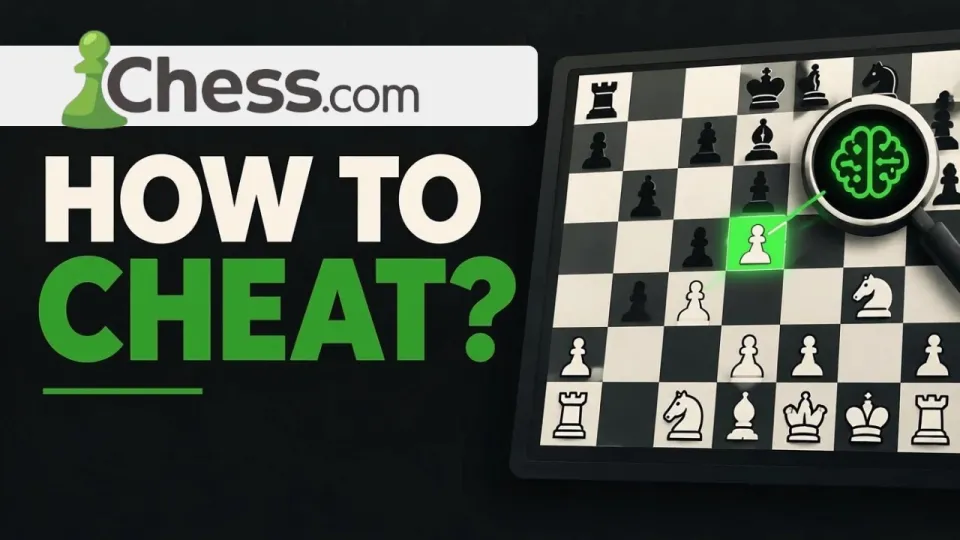
· based on the channel Matyc
Cheating on Chess.com means running a browser extension or userscript that reads the board, feeds the position to a chess engine such as Stockfish, and shows the best move in a small overlay while you play. The tools are installed outside the official store, usually from a site like xmods.cc, where the chess.com cheat extension is hosted, and they work in the browser on desktop rather than in the mobile app. The method is technically simple; the risk is not, because Chess.com's anti-cheat is built specifically to detect this pattern of play.
How Chess.com cheat extensions actually work
An engine overlay is a small script that watches the page, extracts the piece positions, and returns an evaluation. Nothing is injected into Chess.com's servers; the advantage exists only on your screen.
- The extension loads on the chess.com domain and hooks into the board element that renders the pieces.
- After every move it converts the visual board into FEN, the standard text notation for a position.
- That FEN string is sent to a local or remote Stockfish build, which returns the top lines and an evaluation score.
- The suggested move is drawn in a panel or as an arrow on the board, and you play it manually.
Some builds run entirely in the browser through WebAssembly, which means no separate engine download. Others are installed as a Tampermonkey userscript, which is why "chess.com tampermonkey" is a common search variant. In every case the tool needs the desktop web version of the site, because the mobile apps do not expose the same page structure.
Step-by-step installation of a chess.com cheat extension
The installation is a standard browser extension sideload, and it takes a few minutes rather than seconds. The exact menu names differ slightly between Chrome, Edge and Brave, but the flow is the same.
- Download the extension package from the source page, typically a ZIP or CRX file.
- Open the browser's extension manager and enable Developer mode.
- Choose "Load unpacked" and point it at the extracted folder, or drag the CRX file into the window.
- Pin the extension so its icon is visible in the toolbar.
- Open chess.com in a new tab, log in, and start a game. The overlay appears next to the board.
- If nothing appears, refresh the page after the game has loaded, since the script needs the board to exist before it can read it.
For the userscript route, install Tampermonkey first, create a new script, paste the code, and save. The script then runs automatically on every chess.com page.
Why the Chess.com anti-cheat still catches most cheaters
Chess.com does not need to detect the extension itself; it detects the results. Its detection is statistical and compares your moves with what strong engines would play in the same positions.
The signals that matter most are accuracy in complex middlegame positions, the percentage of moves that match an engine's first choice, the time spent per move, and consistency across many games. A player rated 900 who suddenly finds the only defensive resource in a sharp tactical position, game after game, produces a pattern that is essentially impossible for a human. Playing fast makes it worse: matching engine moves in two seconds is a stronger signal than matching them after a long think. Chess.com also reviews accounts reported by opponents, and closed accounts are published in periodic fair-play reports.
Typical problems and how players troubleshoot them
Most failures come from the page not being fully loaded or from the browser blocking the script. The questions that come up most often after a first install are about the overlay not appearing, moves not updating, and games not starting.
- The panel does not show up: reload the chess.com tab while the extension is enabled, and confirm the extension has permission for the chess.com domain.
- Moves stop updating after a few turns: the board parser lost the position, usually after a promotion or a castle; refreshing the page fixes it, but the game clock keeps running.
- The extension is not visible in the store: these tools are not published on the Chrome Web Store, so search there will not find them; they are distributed as files from third-party pages.
- Nothing works on a phone: the extensions target the desktop web client, and there is no equivalent for the iOS or Android app.
- The evaluation looks wrong: a low-depth engine setting or a stale cached position produces bad suggestions; higher depth costs time you may not have on the clock.
The real cost of using chess.com cheats
A ban on Chess.com removes the account, not just the rating. When an account is closed for fair play, the games are annulled, the rating is gone, and titles or prize eligibility earned in those events can be revoked.
There is also a practical ceiling: engine assistance teaches you nothing about calculation or opening preparation, so your genuine rating does not move. Players who rely on overlays often find that they cannot play a single serious game without the tool, and their results in over-the-board chess stay exactly where they were. If the goal is a higher rating that survives contact with a real opponent, the same engine is more useful as an analysis tool after the game than as a live crutch during it.
Conclusion
Chess.com cheating in 2026 is a browser-extension problem, and the extensions work exactly as advertised: they read the board, query Stockfish, and show a move. What they cannot do is hide the statistical fingerprint, which is why accuracy spikes and engine-matching rates are the fastest route to a closed account. The video breakdown by the channel Matyc walks through the installation of one such tool and is the reference for the steps above. If you want to look at the package yourself, the chess.com cheat extension page on xmods.cc is where the download lives — treat it as a demonstration of how the technique works, not as a shortcut worth keeping on your main account.
Key takeaways
- Chess.com cheat tools are browser extensions or userscripts that read the board position and display engine moves in a side panel.
- The most common engine behind these tools is Stockfish, which evaluates positions far above human level.
- Chess.com's anti-cheat compares your moves against engine output and flags accounts with abnormal accuracy, especially in longer games.
- Chess.com cheat tools are distributed through third-party sites such as xmods.cc, not through the Chrome Web Store.
- Bans on chess.com are account-level: flagged accounts lose ratings, game history and access to prize events.
Questions & answers
How do I actually use a chess.com cheat extension during a game?
Install the extension, open chess.com in the same browser, and start a game. The overlay reads the board after each move and displays a suggested move; you still have to play it yourself with the mouse. If the panel is empty, reload the tab once the board is visible.
Can Chess.com detect that I am using an engine?
Yes, in most cases. Chess.com's anti-cheat analyses move accuracy, the share of moves matching engine choices, and thinking time across many games. A sudden jump in accuracy in complex positions is the classic flag, and it leads to account closure and annulled games.
Does the cheat work on the Chess.com mobile app?
No. These extensions and userscripts target the desktop web client, where the page structure can be read by a script. The iOS and Android apps do not expose the same board data, so there is no equivalent install path on a phone.
Why can't I find the extension in the Chrome Web Store?
Tools like this are not published on official extension stores, because they violate the platform's rules and would be removed. They are distributed as ZIP or CRX files from third-party sites, which is why installation requires Developer mode or a userscript manager such as Tampermonkey.
Source: How to cheat in Chess.com (Chess.com cheats) · Markdown version